Sunflower Lanyard

Some disabilities, conditions or chronic illnesses are not immediately obvious to others. For some people, this can make it hard to understand and believe that someone, with a “non-visible” condition genuinely needs support. Some people question whether you have a disability because you don’t look ‘like you have a disability”.

That is why they created the Hidden Disabilities Sunflower – to encourage inclusivity, acceptance and understanding.

It is a simple tool for you to share that you have a hidden disability voluntarily. Simply by wearing the Sunflower, you’re just letting everyone know that you might need extra help, understanding, or just more time.

It allows others to understand that the wearer may need a helping hand, understanding, or more time in shops, at work, on transport, or in public spaces. More places are becoming “sunflower friendly” including airports and larger shopping centres like Westfield.

It’s also recognised internationally.

To buy: https://hdsunflower.com/au/sunflower-lanyard-and-id-card-1.html

School Refusal

Should we force a child to go to school?

In short, no. Working together with your child and addressing the reasons they don’t want to go to school should be the priority. It is important that they feel safe and that their well-being is important to you.

It is recommended that a dialogue is opened with the child. Questions should be asked so you can get to the core reason that school refusal is taking place.

Possible questions:

  • If you could change one thing about your school, what would it be? 
  • Is there anyone bothering you at school?
  • How can I help you with school?
  • Are you worried about anything at school? 
  • How are your friendships at school going? 
  • Is anything worrying you in general?
  • Is there anything you wish your teachers knew?
  • Is there anything you wish I knew?

Strategies for dealing with school refusal:

  • Stay calm – This leaves space for your child to come to you in a calm way themselves.
  • Use positive language – For example, instead of ‘are you going to get up and go to school today?’ try ‘what shall we do after school today?’.
  • Debrief daily – Open the lines of communication for your chid to share what might be bothering them.

School refusal can be very complex:

  • Get professional guidance – starting with school staff. Speak to the class teacher, school counsellor, student services so you can work together as a team to help your child overcome their anxiety.
  • Speak to your doctor/paediatrician and get the support of a psychologist or counsellor who may also help to unlock why your child is not attending school and help address the problem of getting them back to school with their well-being in mind.

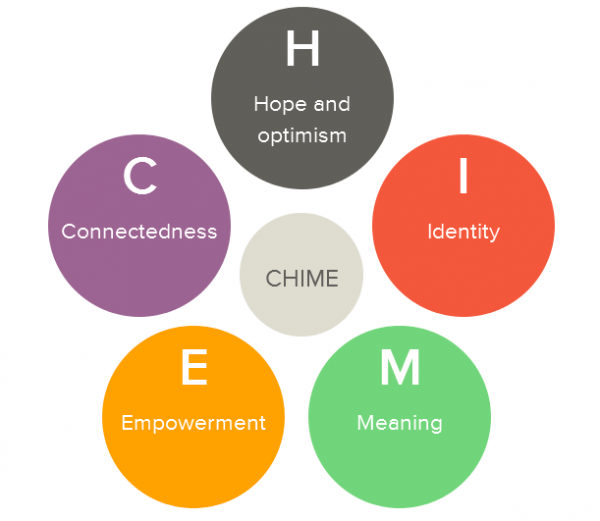
CHIME – A Framework for mental health recovery

Connection

Contact with peers

Good relationships

Support from others

Being part of the community

Hope

Optimism about the future

Believing in health

Feeling motivated

Positive thinking

Having dreams and aspirations

Identity

Having a positive sense of yourself

Feeling able to be yourself

Dealing with stigma

Seeing the whole person

Meaning

Making sense of your experiences

Knowing what’s important to you

Having purpose

Understanding your world

Feeling valued

Empowerment

Being responsible for your own wellbeing

Feeling capable

Being able to see your strengths

Learning by doing

Anxiety Strategies & Techniques – (3-3-3)

I will be writing a series about some simple techniques which could help children and adults with triggered anxiety to help manage their symptoms. (Please note that severe anxiety which is impacting significantly on a person’s life may need the intervention of medical professionals and trained therapists).

The 3-3-3 technique is a wonderful tool to use with children as it is easy for them to remember. The objective is for them to feel more mindful, focused and grounded when their anxiety is starting to feel overwhelming.

3-3-3 involves the person identifying 3 objects around them they can see, 3 things that they can hear and moving 3 body parts (ie their fingers, wrists and toes). It works to reconnect the person with their physical surroundings and become aware of their body movements instead of their symptoms of anxiety like intrusive thoughts. Some steps from Choosing Therapy:

Step 1: Focus on 3 Objects You Can See

Focusing on things that you can see helps you become visually aware of your surroundings. You can notice big objects such as a tree or a chair, or you can look for smaller, more discreet objects such as a pencil or a coin. The idea isn’t necessarily to have objects in mind that you want to see, but rather to focus on the world around you. This helps you deal with your anxiety by removing you from the mental chatter causing you stress.

Step 2: Focus on 3 Things You Can Hear

Pinpointing sounds is another great way to help you deal with anxiety. Diverting your attention to your environment can help you transition from a state of inward thinking to one in which you’re connected to your surroundings instead. However, depending on your location, you may have a hard time isolating sounds. Some things to listen for include a clock ticking, clacking of keys on a keyboard, or someone sniffling. If you are somewhere outdoors, you may notice leaves rustling in the wind, cars passing by, or dogs barking.

Step 3: Focus on 3 Things You Can Touch/Move

Lastly, find three things that you can touch or move. These can be within your reach or even parts of your body. Identifying tangible items is one of the fastest ways to ground yourself when you’re feeling anxious. Teaching yourself to focus on the physical environment helps you feel anchored and reminds you to be present.

Is Vitamin B6 helpful for anxiety?

My son’s neurologist suggested that Vitamin B6 could be tried to help lessen my son’s anxiety. He is having focal seizures, is autistic and non-verbal. While not a cure for anxiety, it was something that could be tried to help with symptoms.

It seems there are only small studies on its effectiveness for both anxiety and depression, but I did find a study showing that Vitamin B6, increases the body’s production of gamma-aminobutyric acid (GABA), a chemical that blocks impulses between nerve cells in the brain.

In the study, David Field, PhD, from the School of Psychology and Clinical Language Sciences at the University of Reading, said that Vitamin B6 helps the body produce a specific chemical messenger that inhibits impulses in the brain, and our study links this calming effect with reduced anxiety among the participants.”

The dose of Vitamin B6 was high in this study, 100mg. This would suggest that eating food rich in B6 may not be enough to make a substantial difference. However, it could be a worthwhile first step to increase foods with naturally occurring B6. Foods high in Vitamin B6 include fish, chicken, tofu, pork, beef, sweet potatoes, bananas, potatoes, avocados, and pistachios. 

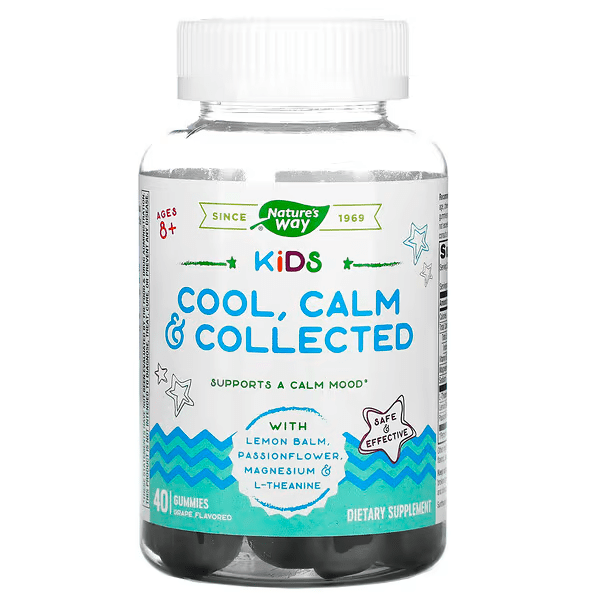
I did end up trying a supplement which had Vitamin B6 in it and other calming ingredients which was formulated for children 8+. While definitely not a cure, the anxiety symptoms he was displaying at the time have definitely lessened. I saw an improved mood after about 2-3 weeks. The neurologist suggested using the brand Blackmores, who have a supplement with high Vitamin B dosages. I was unable to try this because my son cannot swallow tablets. However this may be something others might like to try.

Beyond Nuggets – Food Aversion

Many children with ASD have very particular food palates and this can cause a lot of stress at home when this palate will not go beyond their restrictive favourites – often chicken nuggets which are dry, crunchy and very predictable in smell and texture.

I often get asked how to help children explore different foods and this is not a simple process. Often aversions can be related not only to texture, but the mixing of foods (ie spaghetti bolognaise), the temperature and how it is presented. For instance, eating a strawberry may not be palatable using fingers but may be accepted using a fork or given pureed in a fruit pouch. Experimenting with different cutlery, divided food dishes (so foods are not touching) and in different forms is a good first step.

The “SOS Approach To Feeding” could be tried to help expand a child’s view of food. This can be a very slow process and needs a lot of time and patience. Please do speak to a qualified speech pathologist or eating therapist who can help guide you through the steps if you need more assistance and support.

Getting Started

Step 1 Choose the right food to encourage: Consider some foods that are similar to the ones that your child already tolerates eg if they like chicken nuggets, try chicken schnitzel and also choose a food to try that is as consistent and familiar as possible.

Step 2 Start at a distance: Present the food away from your child, then move it closer once tolerated.

Step 3 Discover the food together: What are its colours, texture, temperature etc?

Step 4 Get closer: If your child feels confident, they may be able to move the food with a utensil, pick it up with their fingers or touch it to their body (on their arm or leg, for instance) or face. It’s important that all exploration is done in a fun and playful manner as we learn most, and will challenge ourselves most, when we are having fun.

Step 5 Once it feels ok to have a food around the mouth, you might be able to touch or hold it with the lips, then a lick or three seconds on the tongue.

Step 6 Rockets and Spit Cups: Once your child feels comfortable playing and exploring with food around their mouth, it’s time to include rocketing (spitting it out with some force while you yell rocket!) into the bin and using a spit cup. The spit cup is especially helpful as it will allow your child to taste, bite or crunch a food without pressure to swallow it. From there, multiple chews may be possible and eventually a swallow.

Calming Sensory Strategies

Here are some simple yet effective calming strategies to help your kids regulate when overwhelmed:

Music Playing gentle music is soothing and allows the brain to fall back into a gentle pattern.

Other Sounds Waterfalls, soft drumming, nature sounds – try finding them on YouTube.

Lighting Soft lighting – fairy or dimmable night lights.

Mindful Colouring or reading.

Connect with Nature Go for a walk, create a treasure hunt and collect different objects you find or play a game of ISpy.

A mindful walk Listening to the sounds around you, looking at colours, taking in the different smells.

Playing with balloons Keep the balloon off the ground but have them move slowly and gently.

Texture bag Place several small objects in a bag. Have your child reach in and touch an object, one at a time, and describe what they are touching.

Apps To Help Gross Motor Skills

iPad apps don’t have to be just about sitting in front of screen. These apps recommended by Source Kids encourage movement and a chance to practice some key motor skills.

Kids Yogaverse: I Am Love

GONOODLE: Make screen time active with 300+ dance videos, yoga exercises, and mindfulness activities for kids! GoNoodle was developed by a team of seasoned designers, educators, child development specialists, and researchers.

JUMP JUMP FROGGY 2: Get a jump start on physical fitness and fundamental mathematical concepts while exercising body and mind with Flip the Frog and his colourful friends. Your physical motion in the real world controls the action simply hold your device in your hands and jump! The higher you jump, the higher the frog jumps!

DEM DANCING BONES: Learn anatomy while you move and groove together! Dem Dancing Bones is a hilarious take on the well known traditional anatomy song. Your kids will absolutely love the funny dances performed by this cartoon Skeleton named Mr. Bones.

KIDS YOGAVERSE: I AM LOVE: The iPad app teaches 13 poses and breathing techniques set to music with vibrant backdrops. We step onto our magic mat and fly through the ancient lands of Egypt. We are as strong as a mountain, as silly as a Laughing Dove and as playful as a dolphin. Dive deep into the Red Sea to discover indigenous curiosities, like a long-lost sphinx!

SWORKIT KIDS: Within the popular Sworkit workout app there is a free kids workout section with a variety of fun workouts to help get those wiggles and giggles out. With each exercise presented visually, the app guides students through exercise routines focusing on strength, agility, flexibility, and balance, such as doing the crab crawl, squats, or side plank.

SUPER STRETCH YOGA: Move, play and breathe as Super Stretch introduces you to his friends and their yoga poses. Super Stretch is your guide who takes you on your journey. Using storytelling, animation and video examples, kids enjoy making NAMASTE a part of their day.

The 7 Drops

Working with children can be a challenge, especially if they are not keen to work with you in return. This list outlining ‘The 7 Drops’ is something all practitioners and educators can try to aid building connections and relationships with the children they work with.

Drop your voice – lower your pitch. Show interest in what the child is doing with your voice, your facial expressions and body language.

Drop your body – get down to their level. If they are on the floor playing, ask to join in on what they are doing. Initiate taking turns if they will accept it.

Drop what you are doing – take your time to get to know them. Leave note-taking and other work for later, make spending time with them your priority.

Drop your guard – let them take risks. Encourage them to try different things and get messy and creative while doing it.

Drop your defences – keep your agenda to yourself. This is about the child’s development. Building a real connection and relationship needs to come from an authentic place. Set goals with the child so you are working towards the same outcomes.

Drop your batteries – turn your devices to silent and give them your full attention. This creates less distraction for you and good role-modelling for them.

Drop your misconception that fun is frivolous – learning through play is powerful. Rediscover your inner child and follow their lead. Have fun!